
Timepix
|
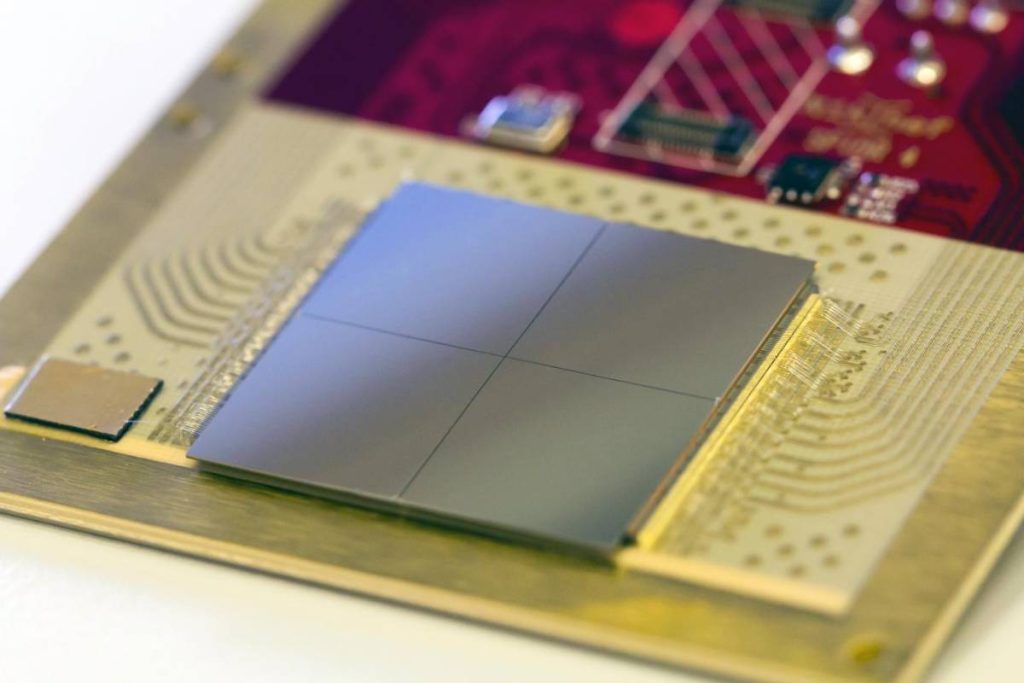
The original Timepix ASIC is a silicon chip developed at CERN by the Medipix2 Collaboration. The chip is divided into a 256×256 grid of tiny pixels, each one containing thousands of transistors that allow it to detect and analyse radiation.
Its successor, Timepix2, can be programmed to operate in one of several modes depending on the application requirement, offering increased complexity compared to the predecessor. Readout is frame-based. The arrival time (Time-of-Arrival – ToA) and charge deposit information (Time-over-Threshold – ToT) can be recorded for each hit when used in sequential read/write mode. In continuous read/write mode one can choose between ToT, ToA or event counting. There are a total of 28 bits per pixel which can be allocated depending on the read/write mode chosen and the requirements of the application.
Timepix3 is a general-purpose integrated circuit suitable for readout of both semiconductor detectors and gas-filled detectors. Compared to the original Timepix the circuit has more functionality, better time resolution and more advanced architecture for continuous sparse data readout with zero-suppression. Timepix3 can be used in a wide range of applications varying from X-rays imaging to particle track reconstruction.
Depending on the application requirements, users can choose one of three data acquisition modes. In the data driven mode both arrival time information and charge deposit information are sent off chip for each hit together with the coordinates of the active pixel. The chosen architecture allows for continuous and trigger-free readout of sparsely distributed data with the rate up to 40Mhits/s/cm2. For imaging applications and for calibrations the chip can operate in frame-based (non-continuous) data readout mode.
With Timepix4 users can choose between several data acquisition modes depending on the application requirement. In data driven mode, the arrival time (Time-of-Arrival – ToA) and charge deposit information (Time-over-Threshold – ToT), as well as coordinates of the active pixel, are provided for each hit. For imaging applications and for calibration, the ASIC can be operated in frame-based mode in either continuous read/write or sequential read/write mode.
Specifications
| Timepix (2006) | Timepix2 (2018) | Timepix3 (2013) | Timepix4 (2019) | |||
| Tech. node (nm) | IBM 250 | TSMC 130 | IBM 130 | TSMC 65 | ||
| Pixel sixe (μm) | 55 | 55 | 55 | 55 | ||
| # pixels (x x y) | 256 x 256 | 256 x 256 | 256 x 256 | 448 x 512 | ||
| Sensitive area | 1.98 cm2 | 1.98 cm2 | 1.98 cm2 | 6.94 cm2 | ||
| Number of sides for tilingusing WB | 3 (87.1% active area) | 3 (85.6% active area) | 3 (86.7% active area) | 2 (93.7% active area) | ||
| Number of sides for tilingusing TSV | No TSV ready | 3 (85.6% active area) | 3 (91.6% active area) | 4 (99.3% active area) | ||
| Front-end | positive (h+) | Gain (16mV/kh+)(Volcano >0.8MeV/pixel) | High Gain (25mV/kh+)Logarithmic Gain (19mV/kh+) | High Gain (45mV/kh+)(Volcano >0.3MeV/pixel) | High Gain (35mV/kh+)Low Gain (20mV/kh+)Logarithmic Gain | |
| negative (e-) | Gain (16mV/ke–) | High Gain (25mV/ke–) | High Gain (45mV/ke–) | High Gain (35mV/ke–)Low Gain (20mV/ke–) | ||
| Minimum detectable charge | ~750 e– | ~600 e– | ~500 e– | ~500 e– | ||
| Operation Modes | Tracking(Event arrival time and/or energy) | Readout | Full Frame-based(Sequential R/W) | Full Frame-based (Sequential or Continuous R/W) | Data-driven(48-bit packet per pixel hit) | Data-driven(64-bit packet per pixel hit) |
| Event Data | TOT or TOA | TOT and TOA; TOT or TOA | TOT & TOA | TOT & TOA | ||
| TOT energy resolution | <3keV (FWHM Si) | ~0.75keV (FWHM Si) | ~2KeV (FWHM Si) | ~1KeV (FWHM Si) | ||
| TOA bin size | 10ns (@100MHz) | 10ns (@100MHz) | 1.56ns (On-pixel TDC @40MHz) | 195ps (On-pixel TDC @40MHz) | ||
| TOA dynamic range | 118.1µs (@100MHz) | 2.62ms (@100MHz) | 409.6µs (14b@40MHz) | 1.63ms (16b@40MHz) | ||
| Max Rate | <1×10⁶ hits/cm2/s (with 300µs readout dead time) | <1×10⁶ hits/cm2/s | 43×106 hits/cm2/s | 358×106 hits/cm2/s | ||
| Max Pix Rate | 33 Hz/pixel | 33 Hz/pixel | 1.3 KHz/pixel | 10.8 KHz/pixel | ||
| Imaging(Event counting) | Readout | Full Frame-based(Sequential R/W) | Full Frame-based (Sequential or Continuous R/W) | Zero-suppressed (with pixel addr)(Sequential R/W) | Full Frame-based(Continuous R/W) | |
| Counter depth | 14-bits | 10-bit or 14-bit | Counting (10-bit) or iTOT (14-bit) | 8-bits or 16-bits | ||
| Frame rate | 100 fps @1x100Mbps 3.2 kfps @32x100Mbps | 4.9 kfps @10-bit 32x100Mbps3.5 kfps @14-bit 32x100Mbps | 1.62 kfps @48-bit 8x640Mbps | 89.2 kfps @8-bit 16x163Gbps44.8 kfps @16-bit 16x163Gbps | ||
| Max Count Rate | ~35 x 109 hits/cm2/s | ~35 x 109 hits/cm2/s | ~82 x 109 hits/cm2/s | ~800 x 109 hits/cm2 /s | ||
| Maximum Readout bandwidth | 3.2Gbps (32 x 100MHz) | 3.2Gbps (32 x 100MHz) | ≤5.12Gbps(8x SLVS@640 Mbps) | ≤163.84Gbps (16x @10.24 Gbps) | ||
| Power consumption | 330mW/cm2 (nominal) | 450mW/cm2 (nominal) 165mW/cm2 (low power mode) | 625mW/cm2 (nominal)108mW/cm2 (low power) | 700mW/cm2 (nominal)200mW/cm2 (low power) | ||
| Other | Out of production | |||||
| Paper | https://www.sciencedirect.com/science/article/pii/S0168900207017020 | https://www.sciencedirect.com/science/article/pii/S1350448719305165 | https://iopscience.iop.org/article/10.1088/1748-0221/9/05/C05013 | https://iopscience.iop.org/article/10.1088/1748-0221/17/01/C01044 | ||
Licensing
Timepix, Timepix2, Timepix3 & Timepix4 are ready for licensing.
Key Facts
Technical domains
About the Medipix3 Collaboration
Tech Brief
| Attachment | Size |
|---|---|
| Timepix2 tech brief | 266.89 KB |
| Timepix3 tech brief | 611.89 KB |
| Timepix4 tech brief | 172.56 KB |
Contact Person

Rita Pinho
Knowledge Transfer Officer
Related Articles
Case Studies
- CERN technology helps rediscover lost painting by Raphael
- Timepix-based detectors bring particle physics in the classroom
- Timepix: from CERN’s galleries to the Moon
News
- Characterisation of the Timepix4 for measurements in hospital theatres.
- Development of a non-destructive beam monitor based on Timepix3 for particle therapy (BGI)
News