
Cooling and Ventilation
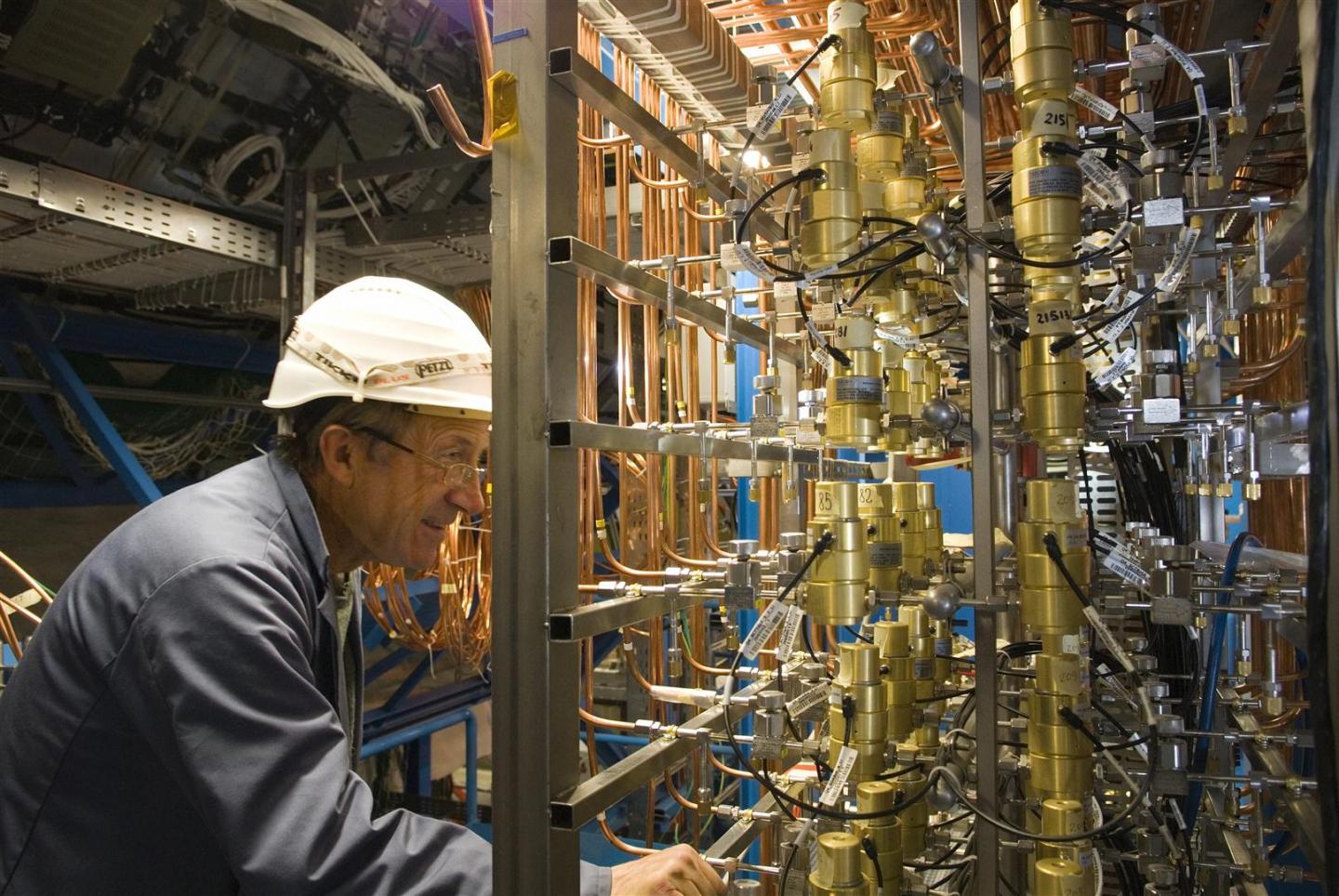
Expertise in procurement, installation, operation & maintenance of large cooling, ventilation and air conditioning systems for complex structures.
CERN’s know-how
- CV systems (air & water) for all accelerator and experiments, mainly in large interconnected spaces
- Expertise for designing large scale cascading pressure systems to ensure safety
- Expertise in the design of CV systems for the removal of high heat loads
Value Proposition
Read more about Cooling and Ventilation here.
Key Competencies
Pressure Cascade Management
The LHC is a very large, complex underground system of interconnected spaces. In order to secure safety, any risks related to fire, smoke, radiation and gas need to be mitigated. This is secured by a complex system that ensures, monitors and controls pressure differences across tunnels and caverns. A few specifications:
- 50 MW of cooling per point, designed as tailored solution for CERN
- 150 cooling plants
- 1500 ventilation systems
- 7600 different industrial CV components
- 800 km of CV piping
High-performance thermal management systems, materials and processes
Whether it is to dissipate the heat generated by electronic components or to extend the service life of silicon sensors, thermal management is one of CERN’s main design concerns. CERN is developing very small and efficient cooling devices capable of operating in harsh environmental conditions of temperature, vacuum and radioactivity.
These devices include innovative pulsating heat-pipe concepts, either as extremely miniaturised devices for thermal control at component level (3D-printed or micro-fabricated in silicon or flexible materials), or as larger ultra-light structures embedded in carbon panels for radiators and cold plates.
Some technologies are especially useful for applications requiring powerful thermal control. Rocket nozzles can benefit from additive manufacturing techniques optimised for refractory metals like niobium. In the same way, titanium is interesting for both accelerators and telecom satellite payloads testing, to shape high power spiral radiofrequency loads. In addition, an advanced alloy with record high thermal conductivity properties has been developed for dissipating extreme heat fluxes.
CERN develops very small and efficient cooling devices, as well as advanced materials and processes for high thermal flux control