
Machine Learning and Deep Learning
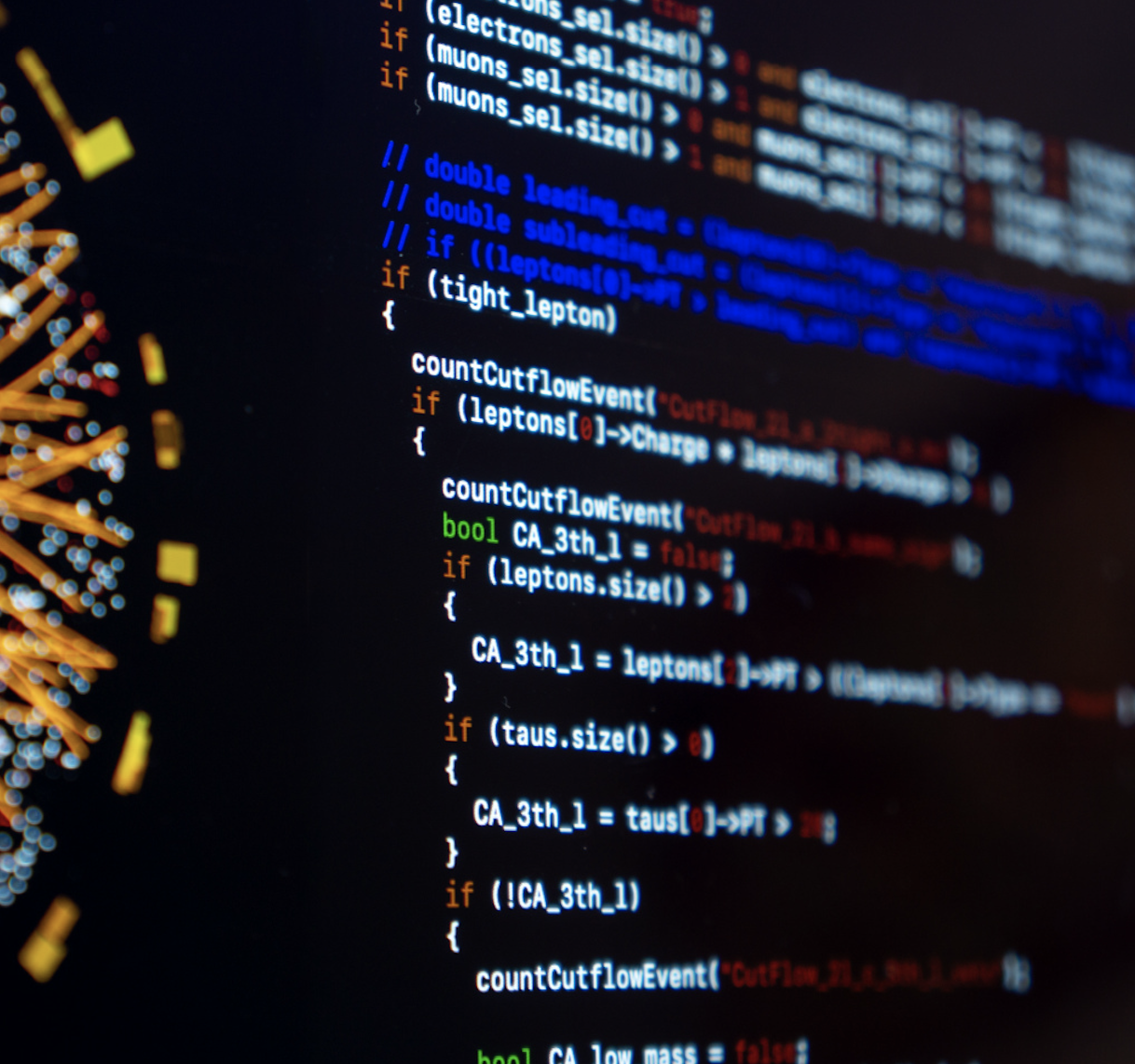
Know-how and experience derived from early adoption of neural network techniques by particle physics community.
CERN’s Know-How
- Particle physicists were among the first to use machine learning (ML) in software for analysis & simulations
- First AI HENP seminar in 1990
- Already in 2010, the CMS and LHCb experiments successfully introduced machine learning algorithms to its trigger system
- Higgs boson discovery earlier than expected (2012), also with help of ML
Facts & Figures
- <10 μsec: ML applied for extremely fast decision making in CERN detector trigger systems
- AUC> 90%: High true positive / low false positive rates achieved even in sparse images with little datapoints
- >1000 times faster: Convolutional neural networks have dramatically decreased computing time in physics (vs traditional computing)
- ~100% efficient: Highly reliable trace reconstruction algorithms using tailored neural network techniques, even with multiple tracks in one sensor
Value Proposition
Read more about Machine Learning and Deep Learning here.
Key Competencies
Designing & Training Neural Networks
CERN has a long history in the design and training of neural networks in for example classification, filtering, event and particle detection, regression, clustering and anomaly detection. Most of the ML/DL codes are tailor made using C++, Phyton, TensorFlow and Keras and applied in software or hardware (FPGAs).
Fast neural network inference in FPGAs
CERN needs ultra fast machine learning interference (execution in μsec), requiring compact code for FPGAs. A companion compiler package for this work is developed based on High-Level Synthesis (HLS) called hls4ml to build machine learning models in FPGAs, allowing for fast prototyping and shorter time to results.
Key Applications
TMVA as Open Source ML / DL Toolkit
The open source Toolkit for Multivariate Data Analysis (TMVA) developed by CERN provides a machine learning environment for the processing and evaluation of multivariate classification, both binary and multi class, and regression techniques. It is integrated in ROOT, a modular scientific software toolkit (C++).
Related Articles
Case Study
Project
- A novel AI-based tool deployed via a federated learning platform to assist in the screening, diagnosis, prevention and therapy evaluation of breast and prostate cancer (CAFEIN2)
- CAFEIN – Federated network platform for the development and deployment of AI based analysis and prediction models
- CAiMIRA
- CAiMIRA project: Expansion of the CARA technology
- Energy, water and gas monitoring and forecasting platform (Web Energy)
- Environmental Modelling and Prediction Platform (EMP2)
- IoT-Enabled Stroke Patient Monitoring and Therapy Evaluation through AI Federated Learning
- MARCHESE – Machine leArning based human ReCognition and HEalth monitoring SystEm
- Quantum Artificial Intelligence for Earth Observation (QuAI4EO)
- SF6-free S-band circulator for photo injectors
- Use of MARCHESE technology in hospital setting
News
- Accelerating stroke prevention
- CERN’s edge AI data analysis techniques used to detect marine plastic pollution
- Colliding particles not cars: CERN’s machine learning could help self-driving cars
- How CERN and Ceva are pioneering the future of Edge AI
- Researchers use CERN technology to evaluate risk of COVID-19 transmission
- Unlocking AI’s true potential in healthcare requires collaboration